







 2026-05-01
 Technical Paper
 Click Count:21
Photochromic Lens Test Introduction and Relevant Tester
I. What Are Photochromic Lenses
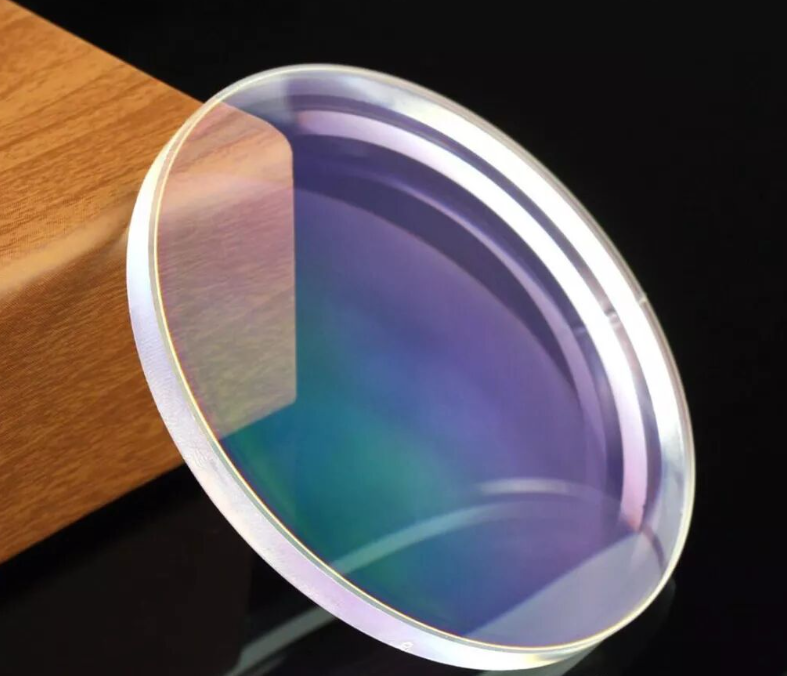
Photochromic Lenses is short for reversible color change induced by light. The term is widely adopted in ophthalmic eyewear. Since Roger Araujo from Corning invented photochromic lenses, photochromic lenses have evolved over half a century. Lens substrates have advanced from heavy glass to lightweight polymer resins, while the color-changing agents have developed from early inorganic silver salts (e.g., silver halides) to high-tech organic photochromic molecules, also known as photochromic dyes. These lenses function as standard optical eyewear indoors and double as sunglasses outdoors.
II. Fundamental Principles
1. Common Classifications of Photochromic Materials
Pericyclic reactions: Spiropyrans, spirooxazines, benzopyrans, etc.
Cis-trans isomerization: Isomerizable compounds such as stilbenes and azo/azine derivatives.
Intramolecular transfer reactions: Divided into hydrogen transfer and functional group transfer.
Hydrogen transfer: Anils, benzylpyridines, salicylic acid derivatives, benzotriazoles, etc.
Functional group transfer: Polycyclic quinones.
Molecular bond cleavage/formation: Triarylmethanes, triarylimidazole dimers, and other substances capable of reversible homolytic or heterolytic cleavage of covalent bonds.
Electron transfer (redox reactions): Viologens undergo reversible color shifts via redox reactions under oxygen exposure.
2. Characteristic Principles of Photochromic Reactions
Reversible chemical transformation occurs between two states (A and B), accompanied by distinct color variation.
Conversion from State A to State B requires absorption of electromagnetic (light) radiation; reverse conversion from State B back to A can be triggered by heat or light.
State A (colorless form) and State B (colored form) feature different light absorption spectra (see Figure 2).
3. Key Properties of Photochromic Lenses
(1) Fast coloration, slow fading
(2) Temperature-dependent color-changing performance
4. Core Manufacturing Technologies
(1) In-mass casting (photo cast in)
(2) Coating technology (photo-coating / trans-bonding)
(3) Imbibing technology
Imbibing refers to a thermal process where photochromic agents penetrate and adsorb into the lens matrix. Most dyes reside within the lens surface layer, similar to the coating technology.
III. Significance of Photochromic Lens Testing
Ensure visual comfort
Function: Photochromic lenses automatically adjust light transmittance based on ambient light intensity to reduce glare stimulation.
Testing purpose: Verify lenses can rapidly and accurately modulate transmittance under varying lighting conditions to deliver comfortable vision.
Protect ocular health
Function: Photochromic lenses filter harmful ultraviolet and blue light to mitigate eye damage.
Testing purpose: Confirm effective UV and blue light blocking across all light environments to safeguard eye health.
Validate photochromic performance
Function: The core feature of photochromic lenses is automatic transmittance adjustment responsive to light.
Testing purpose: Certify fast, stable tinting and fading under diverse lighting to validate core functional performance.
Guarantee consistent product quality
Function: Light transmittance is a core metric for evaluating lens quality.
Testing purpose: Ensure all production batches comply with quality standards for uniform, high-quality output.
Meet regulatory compliance requirements
Function: Eyewear products are subject to stringent standards and regulations in numerous countries and regions.
Testing purpose: Verify full compliance with relevant specifications to eliminate legal risks.
Support R&D and technological innovation
Function: Transmittance testing provides quantitative data to drive technical upgrades.
Testing purpose: Assist R&D teams in optimizing raw materials and manufacturing processes to develop higher-performance lenses.
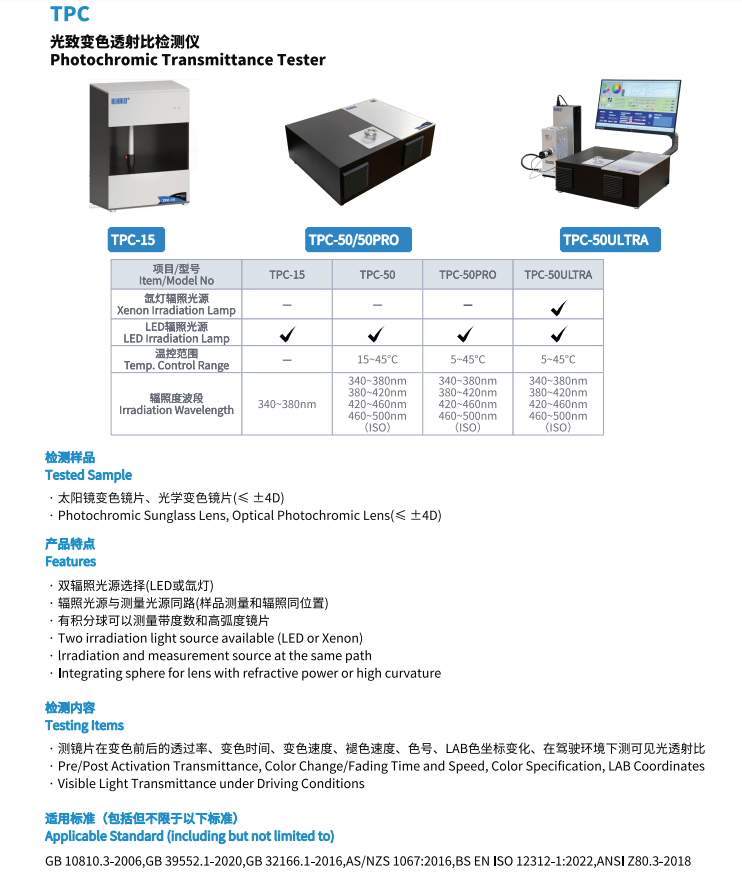
IV. Photochromic Tester
Domestic photochromic lens tester are designed to evaluate core optical parameter including photochromic speed and durability.
The TPC-50 Photochromic Lens Tester is highly recommended for the following advantages: user-friendly operation, coaxial irradiation and measurement light paths, and an integrating sphere that supports testing of curved, power-corrected ophthalmic lenses.