







 2026-10-13
 Technical Paper
 Click Count:21
From IOL measurement to visual performance
How measured optical data can help us understand IOL performance beyond the lens itself
Power, MTF and wavefront measurements allow IOL developers to characterize a manufactured lens and compare designs. But once implanted, an IOL becomes part of an optical system in which the cornea, pupil and lens position can all influence performance.
So how can we connect what we measure on the IOL with what happens when it becomes part of an eye?
It starts with the measured lens
Wavefront measurement provides a detailed description of how the actual manufactured IOL affects light passing through it, including its optical characteristics and aberrations.
By combining this measured wavefront with a model of the eye, we can investigate how the lens interacts with the complete optical system.
Putting the IOL into a model eye
No two eyes are exactly the same. Corneal shape and aberrations vary, as do pupil diameter, astigmatism and IOL position, all of which can influence optical performance.
Model-eye simulations allow the measured IOL to be evaluated with different corneal models, pupil sizes and eye geometries.
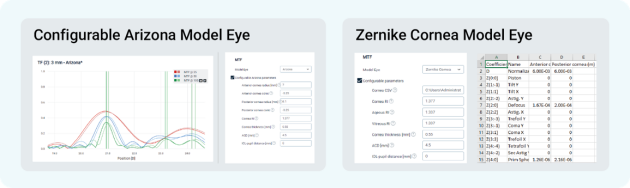
Examples of configurable Arizona and Zernike cornea model-eye simulatio
This is particularly useful during IOL development, where the question is not simply “How does this lens perform?”, but “How does its performance change under different optical conditions?”
Looking beyond a single MTF result
MTF is one of the most established ways to describe optical performance, but any MTF result represents a defined set of conditions.
Through-focus MTF provides a broader view, showing how optical performance changes across a range of defocus. This is particularly relevant for modern IOL designs.
Physical white-light MTF measurements characterize the actual lens under polychromatic illumination, while wavefront-based analysis allows the measured IOL to be evaluated with different model-eye configurations and simulated white-light conditions.
Together, these approaches provide complementary ways to understand IOL performance.
What happens if the IOL is not perfectly positioned?
An IOL can be evaluated with different levels of tilt and decentration to investigate how misalignment affects optical and visual performance.
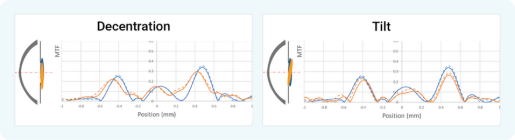
Examples of tilt and decentration analysis based on measured IOL data.
This allows different lens designs to be compared under the same conditions and helps designers understand how sensitive they are to positioning.
For pre-clinical evaluation, this provides valuable information beyond the performance of a perfectly centered lens.
From optical performance to simulated vision
MTF curves and wavefront data provide detailed information about optical performance, but they don’t always make the impact on image quality easy to visualize.
By combining the measured IOL data with a model eye, visual performance simulations can help translate these optical results into visual metrics and simulated image quality.
Letter simulations can illustrate changes in contrast and sharpness across defocus, while halo simulations can visualize effects associated with multifocal and EDoF IOL designs. Visual metrics can also relate optical performance to predicted visual acuity.
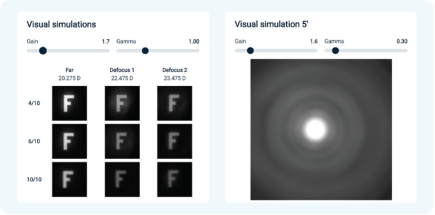
Examples of letter and halo simulations based on measured IOL data.
These simulations do not predict exactly what an individual patient will see. Vision also involves retinal and neural processing. Instead, they provide another way to interpret and compare optical performance and understand what differences in the measurement data could mean for image quality.
Different tools, different questions
There is no single measurement or simulation that tells us everything about an IOL.
Physical measurements, model-eye evaluation and visual simulations each provide a different perspective on IOL performance. Together, they help build a more complete picture of how a lens performs under different optical conditions.
This broader approach is also reflected in ISO 11979-2:2024 Annex C, which introduced additional requirements for pre-clinical optical characterization.
Extending the value of measured IOL data
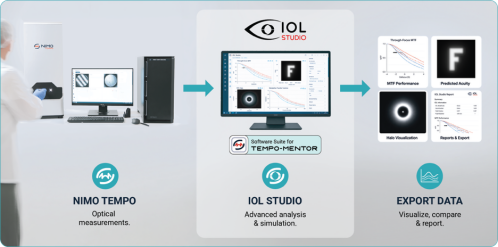
This is the principle behind the IOL Studio software suite from Lambda-X Ophthalmics.
IOL Studio uses measurement data from TEMPO-MENTOR software as the starting point for ISO-aligned evaluation, visual performance analysis and configurable model-eye simulations.
The goal is simple: to get more insight from the IOL measurement data you already have.
From evaluating the measured lens itself to exploring its performance under different model-eye and visual conditions, IOL Studio extends the value of each measurement throughout IOL development.